

Introduction to the Subjects Dictionary
The Subjects Dictionary was developed in Ruby on Rails for the Tibetan and Himalayan Library (THL) as part of the suite of Knowledge Maps containing three types of fundamental kinds of data: Places, Subjects and Terms. Subjects Dictionary is running here. All code was developed as Open Source available at github with an overarching application that groups together ruby gems, which can be founds in the shanti-uva and thl repositories.
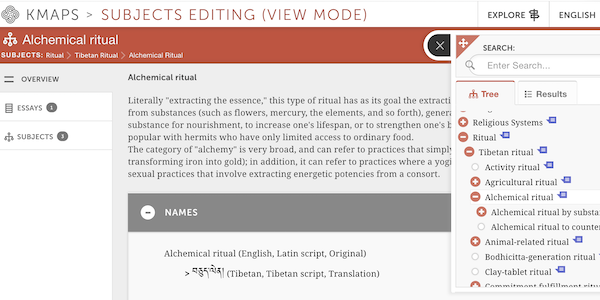
THL invested considerable energy in building a library-wide system for managing semantic maps of various phenomena or areas of knowledge. The key to our approach to the Subjects Dictionary is "knowledge maps", our label for the hierarchies which formally represent specific topics such as Tibetan understandings of the types of animals, literary genres, Buddhist ritual forms, or languages. These maps not only express the hierarchical relationship between categories and subcategories, but also each category - a specific animal, literary genre, ritual type, or language - can be described by a scholar, or multiple scholars. Just as importantly, these knowledge maps in the Subjects Dictionary are used as controlled vocabulary and tags in all other THL applications. Thus rather than each application - the Place Dictionary, or the image database, etc. - building and maintaining its own controlled vocabulary or ontology for a given subject matter, the Subjects Dictionary globally maintain these for all the applications. In this way, the Subjects Dictionary then comes to function as a rich index of a large number of resources which are being indexed with them. For example, if you explore in the Subjects Dictionary a knowledge map of Tibetan rituals, you will be able to potentially see for each type of ritual whatever videos, images, articles, web sites, dictionary terms, or other resources have been indexed as relating to that specific type of ritual. In this way, as scholars work in totally different projects, but all rely upon these common knowledge maps in the Subjects Dictionary, a rich and complex understanding of the areas in question accumulates for end users.
The system also works in the opposite direction, namely the name of any node of a knowledge map in the Subjects Dictionary used to index a resource will be hyperlinked in that resource's metadata to that specific node within the knowlege map. Thus a user can be looking at an image that is tagged as pertaining to a "fire ritual", and then immediately proceed to explore a rich assemblage of scholarly resources on fire rituals.