

Introduction to the Terms Dictionary
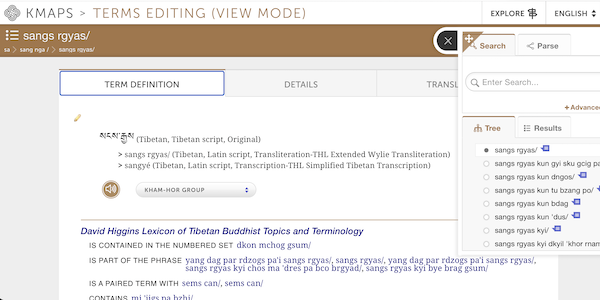
The Terms Dictionary was developed in Ruby on Rails for the Tibetan and Himalayan Library (THL) as part of the suite of Knowledge Maps containing three types of fundamental kinds of data: Places, Subjects and Terms. Terms Dictionary for Tibetan terms is running here under the University of Virginia (UVa). Terms Dictionary for Newar Terms is running here under the University of Toronto (UofT). All code was developed as Open Source available at github with an overarching application (for UVa and UofT) that groups together ruby gems, which can be founds in the shanti-uva, nod-uoft, and thl repositories.
The Terms Dictionary aims at an innovative and long term collaborative integration of glossaries and rich dictionaries. Rather than focus initially on large amounts of data, we have slowly built a long term digital infrastructure to support many scholars collaborating together with an array of individual projects.
Glossaries are in essence simply lists of translations, such that each Tibetan word is given an equivalent word or phrase in the target language. In addition, they can have other limited information such as parts of speech. In contrast, a dictionary is marked by the presence of definitions as well as translations. Standard dictionaries generally offer other categories of information about each term beyond definitions, most typically pronunciation, grammar type, etymology and examples. Pronunciation typically uses a simplified phonetic scheme for representing the sounds of the words in the source or target language, or use the international standard for phonetic representations known as “IPA” (international phonetic alphabet). In digital and on-line dictionaries, pronunciation is also often represented with a sound file giving the actual sound of the word. Grammar type typically uses abbreviations – such as V for verb and s forth – drawn from an analytical scheme representing the language’s grammar. Etymology discusses how the word is derived from older forms in the language, as well as other languages originally, to delineate the historical formation of the word in brief. Finally, examples give example sentences illustrating the usage of words in phrases and sentences. Other such categories found in standard dictionaries can including “typing” of words, such as indicating archaic words, regional expressions, and so forth, and the indication of related words such as compounds, synonyms, antonyms and so forth.
It began under THL at the University of Virginia, where the platform was first developed and the most important Tibetan dictionaries were imported, breaking them down into specific fields in a database. Currently, I continue to actively develop it for the Newar Online Dictionary at the University of Toronto, where Newar dictionaries are being digitized and imported. As a personal project, I am also using it in the production of a Tibetan-Spanish dictionary to standardize technical vocabulary.